Impulse Measurements
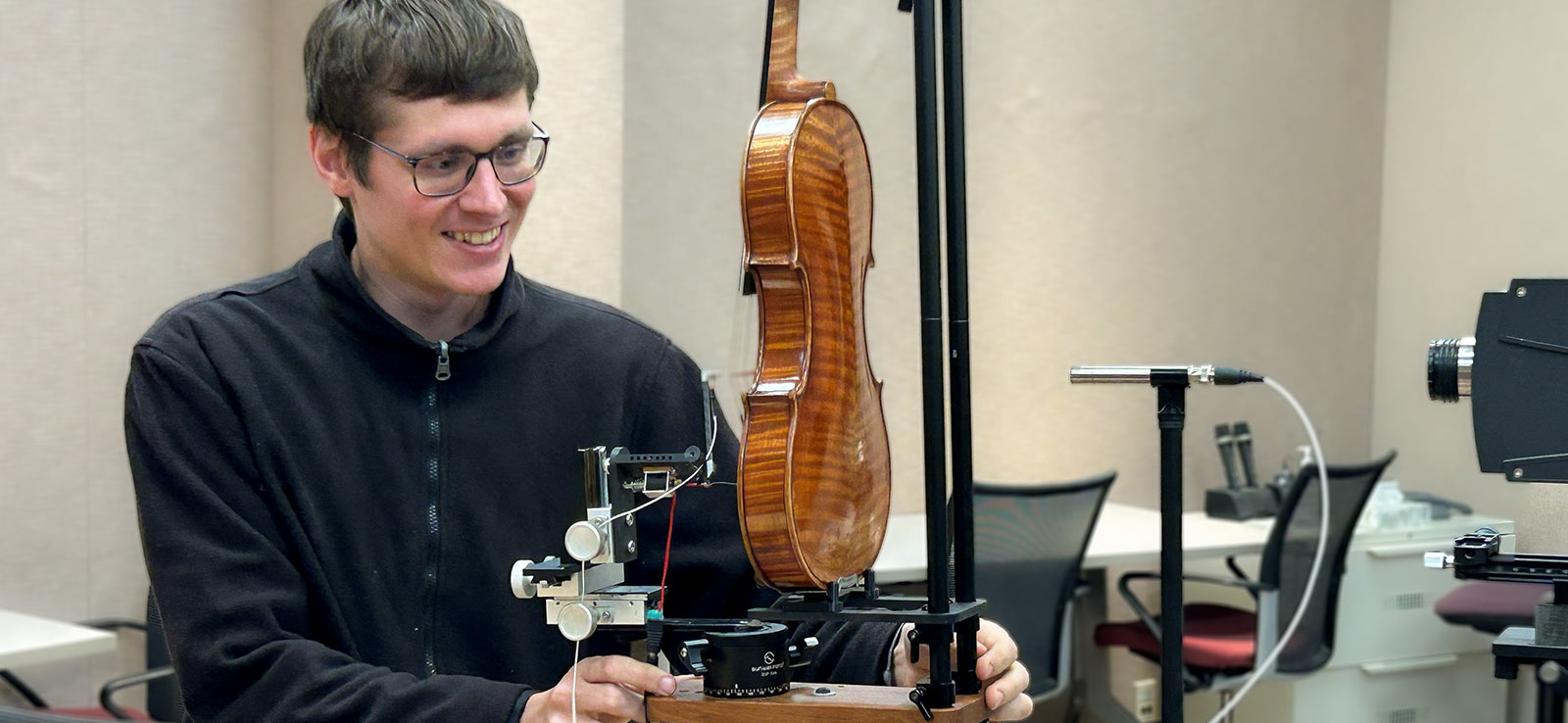
A now standard way of measuring violin sound radiation is to tap the bridge with a miniature impulse hammer while a microphone picks up the resulting sounds. In 2010 Joseph Curtin introduced a rig designed to make the measurement process convenient and portable. Since then, the design has been refined through several generations and field-tested in workshops, concert halls, and laboratories. The current model was developed by Curtin and Magdelana Marino for the 2026 Oberlin Workshop as a turn-key measurement system. It is more portable and versatile than previous versions, and because it includes a hammer and microphone, it is significantly less expensive. A violin or viola can be taken through a cycle of 24 individual measurements in less than ten minutes. In another ten minutes, the rig can be disassembled and packed into a box (18 in x 12 in x 8 in) or carry-on suitcase.
How it works
The head of the impulse hammer weighs about 1.5 grams and contains a piezo force sensor. When a violin bridge is tapped, the instrument body is set into vibration, and the resulting sound is measured by a microphone. To process the data, the microphone signal is divided by the force signal to give a frequency response function representing sound pressure at the microphone position, per-unit-force at the bridge, a measure of radiativity. Measurements are typically made a 12 points around the instrument to help account for the directionality of violin sound radiation. This cycle can be done with the hammer tapping in two different directions (horizontal and vertical), the goal being to excite all the vibrational modes that can be excited by the bowed string. For an in-depth discussion of this process, see “Measuring Violin Sound Radiation Using an Impulse Hammer”. Bridge admittance can also be measured, but this requires an accelerometer (not included).
Features
- Turn-key system includes rig, hammer, soundcard, microphone, calibrator, and cables. The only other things needed are a standard camera tripod with a ¼” mounting screw and a laptop.
- Rig accommodates violins and violas of any size
- 3-axis positioning stage allows precise alignment of hammer and bridge
- Meaningful data can be gathered to 7 kHz and beyond
- Instruments can be rotated 360 degrees with respect to microphone
- Indexed rotation in 30-degree increments helps ensure repeatability
- Distance between microphone and instrument can be readily changed
- Mounts on standard photo tripod legs (not included)
The rig includes a hammer (made in house), soundcard (Onyx Producer 2.2), and microphone (Behringer ECM 8000). It is also compatible with the PCB miniature hammer (model 086E8) and power supply. Using the rig requires an understanding of the basics of violin acoustics and a working familiarity with the relevant hardware and software. Prospective users should consider getting hands-on experience at the VSA Oberlin Acoustics Workshop. Joseph Curtin can provide only very limited after-sales consulting.
Price: $1,500 plus shipping and applicable taxes. Delivery is currently limited to the USA. As the rigs are individually assembled at Joseph Curtin Studios, a lead time is required. Contact Joseph Curtin to place an order. If you already have a hammer, microphone, or soundcard, the rig can be purchased without them for a discounted price.
Software: The ObieWebApp is a free and continually developing suite of online acquisition and analysis software for impulse hammer measurements. It works only in Chrome: https://chrisbuerginrogers.github.io/ObieApp/Web/
The original ObieApp, which is available for Mac and Windows systems, can be downloaded here: Oberlin Acoustics App – Downloading Software. Note that there is currently no manual for the software, so hands-on training at the VSA Oberlin Acoustics Workshop is recommended.
Camera Tripod Legs: The rig attaches directly to any standard camera tripod with a ¼” stud. This tripod should not have a tilt head, as that introduces possible instability. For maximum portability, consider lightweight tripods with 4-section legs.


